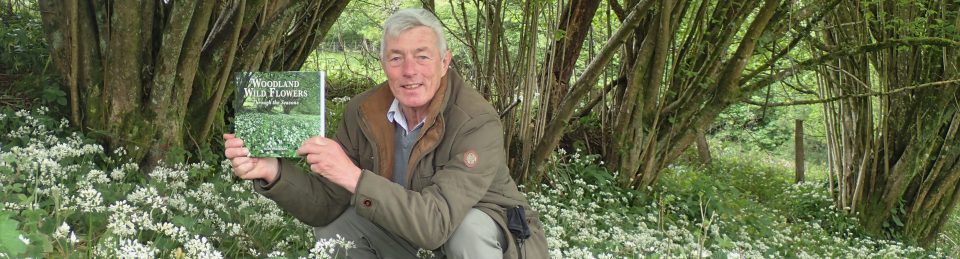
I only realised that I did not have a home page recently when I was inviting someone in the small woodland owners group to have a look at my blog because they were thinking of setting up their own blog.
OK here is the background to our woodland.
In 2013 I moved from Norfolk to Gloucestershire. The house from which I moved was relatively large, and more importantly it had a large garden which also had a drainage dyke running through it. The garden kept me busy and keeping the dyke clear of vegetation was a never ending task. At its best it had areas of open water, with interesting marginal wild flowers like Marsh Marigold, Yellow Flag Iris and Purple Loosestrife but there were also invasive plants like Fools Cress, Common Reed and Duckweed so at times it would be virtually choked up with hardly any open water.
The Gloucestershire house is in a picturesque little village located between the Wye valley and the Forest of Dean and has a relatively small garden. This was chosen on purpose because we do spend several months a year abroad and returning home to an overgrown garden is not a delight. Our little garden can be returned into something quite acceptable with under a day’s work.
My wife was quick to realise that during our periods in the UK, which do make up themajority of our time, this little garden, convenient though it is, was not going to keep me occupied and despite the attractions of the nearby countryside she thought that I would soon be kicking my heels and so suggested the purchase of a piece of woodland. In fairly short measure we became the proud owners of six and a half acres of Welsh woodland. It is just across the Wye valley only about 7 miles from where we live. It was not the most attractive of woodland when we bought it. It was a plantation of Corsican Pines, rows and rows of them which made the wood quite dark and boring. There were a few deciduous trees but they were struggling to survive against the stranglehold of the conifers and in consequence they were very tall, thin and straggly with hardly any structure. These deciduous trees were mostly Oak and Silver Birch with a few Beech and Rowan. Around the edge of the wood there were a few more substantial Oaks and Beech and a few woodland wild flowers, some Bluebells, Wood Anemones and even some Wood Sorrel but mostly the wood was dark and all that grew in the interior were some ferns, predominantly Bracken, and some nasty brambles which were very adept at tripping one up.
It was our intention to gradually improve it by cutting down some of the conifers ourselves and creating little patches of light where flowers might grow….. naive amateurs!
The site was a PAWS site which stands for Plantation Ancient Woodland Site, and this means that it has had trees growing on it continuously since 1800 but at some stage it was converted into a plantation and in our case that was a plantation of conifers. I estimated that it was probably first planted up with conifers in around 1920 and then felled in around 1965 and replanted with the Corsican pines which were growing there when we purchased it, so there had been two generations of conifers. I came to this conclusion because dotted about among the rows of trees there were quite a number of stumps which were well rotted down and loosely arranged in rows and therefore concluded that these were the remnants of the previous felling.
Our patch had been named ‘Catbrook Wood’ by the vendor, which is a well known company selling small plots of woodland to amateurs with romantic ideas of woodland ownership. It names all the woods it sells, I suspect because it makes them sound more desirable. In fact strictly, in my view our plot should have been called Broadstone Wood as the village of Broadstone is just a stones’ throw away and Catbrook is about two miles further on. I have dropped the name Catbrook Wood and removed the turquoise blue painted sign proclaiming it’s name which the company erected. Our wood is now simply referred to by me as ‘a section of Ninewells Wood’. The original sign is now on the front of our wood store at home.
Ninewells Wood covers an area of about 100 acres and is in multiple ownership. The largest area belongs to Natural Resources Wales which is the Welsh section of what was originally the Forestry Commission. As far as I can make out the derivation of the name Ninewells arises from the fact that there may be or may have been nine natural springs in the vicinity. We have a well in our section of the wood but locals are quick to point out that it is not one of the ‘nine wells’. Our well was dug somewhere around the 1930’s as a source of water for the nearby farm, but before it was finished the local council decided to connect all the properties in the area to a piped water supply so it was never needed and never used. Another story which we often get told is that during the final stages of excavation the men working on it left their tools at the bottom one night. That night it rained all night long and in the morning the tools were under quite a depth of water so that is where they remain to this day.

