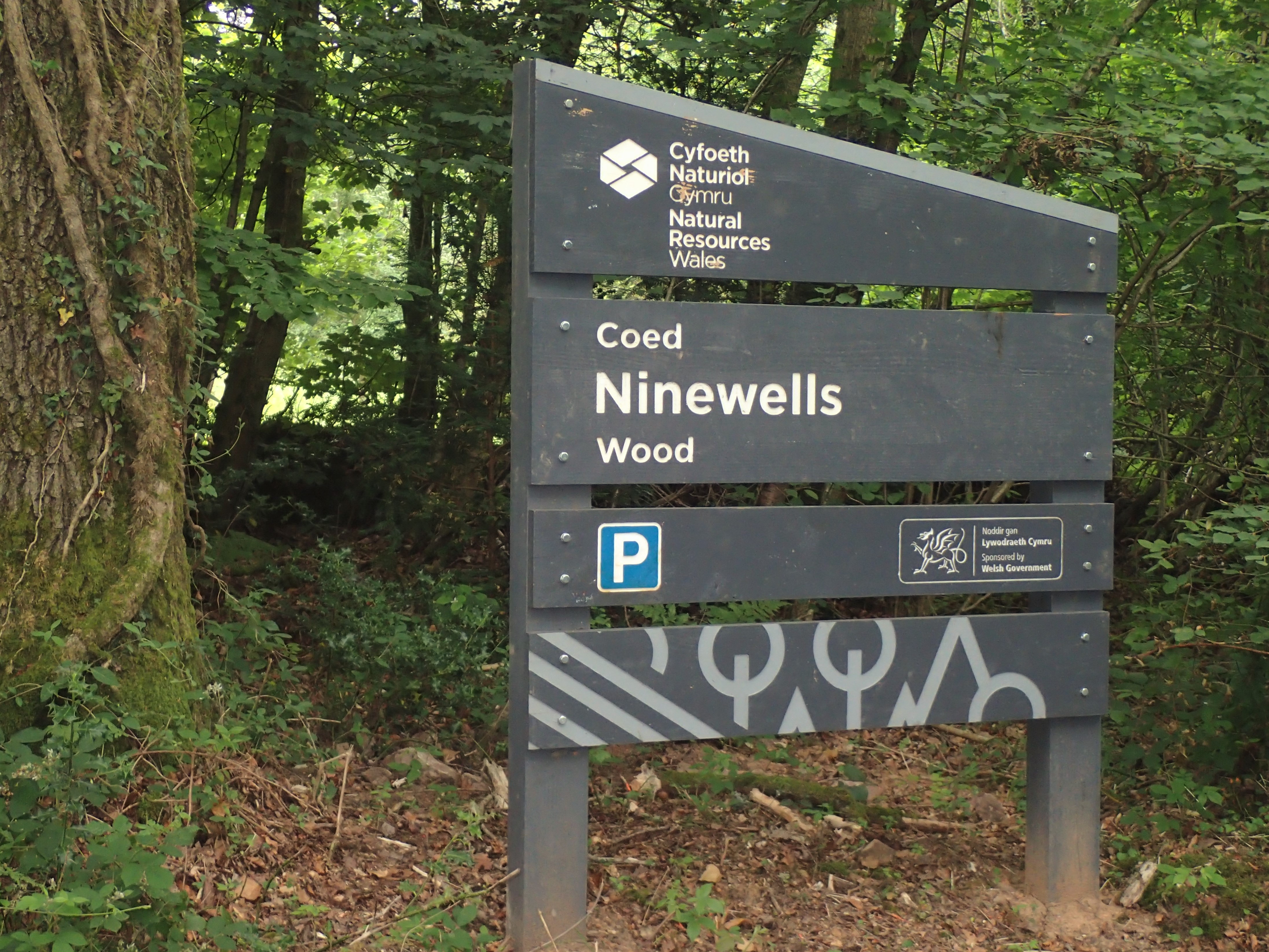
 A few days ago I was privileged to have a walk with Mack and his dog. He took me on a circular walk around Ninewells wood. Catbrook wood is a small portion of the original nine wells wood. When Woodlands for sale buy up woods for subsequent splitting up and resale, they like to give each little bit a name, it makes them more user-friendly and from their point of view more saleable. We set off up the path that splits our wood from the neighbouring wood and then along the edge of Ninewells wood. There is a very substantial stone wall with views across towards the Bristol channel.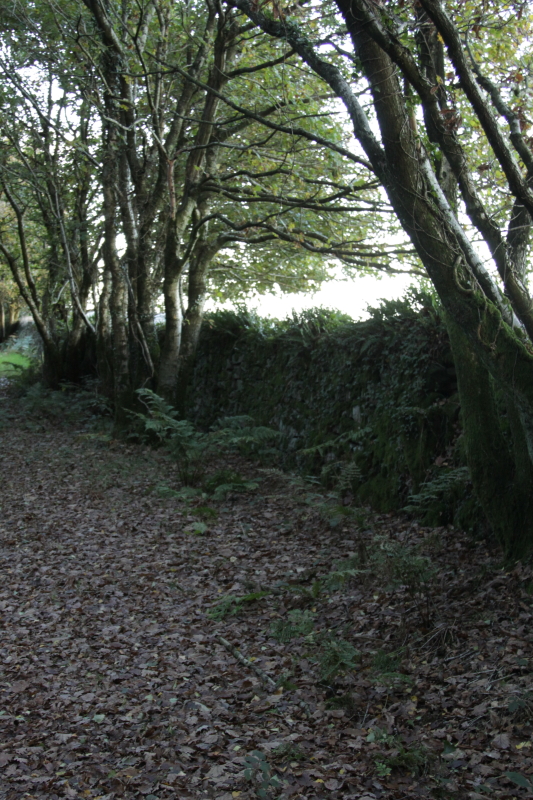
Mack explained that the wall had been constructed by prisoners of war from the Napoleonic wars. These prisoners were stationed on the neighbouring estate which belonged to the Lewis family. ( This is wrong, Mack said it was the Morris family and I did not remember the name but subsequently he put me right and I have now looked into the history of that family.)
Click here to see what I have found out about the Morris family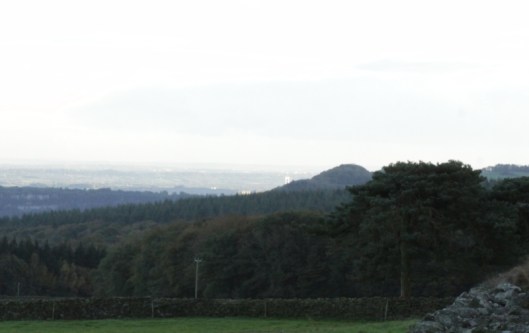
If you get the angle right you can just see one end of the Severn Bridge.
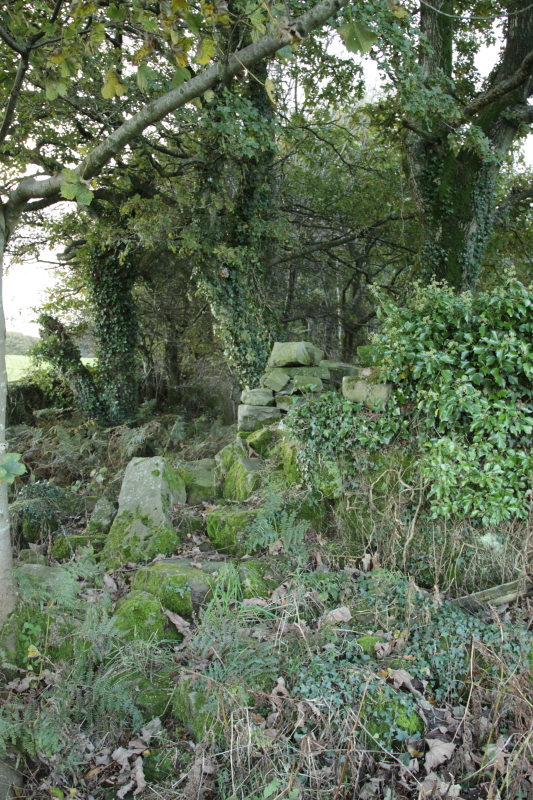
At the end of the wall is a tumbled down tower, this is at a high point and was used, so I am told as a lookout tower where an overseer could watch the workers or prisoners or slaves working on the Morris estate. Mack said the Morris family were involved in the slave trade and had property in the West Indies.
It is certainly a very well constructed wall, in this photo you can see the object of our walk which was a very attractive Springer Spaniel.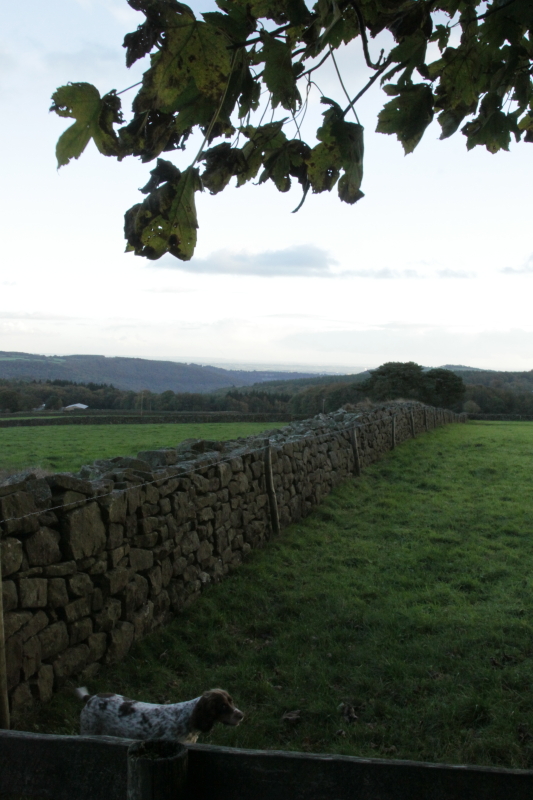
At one place along the wall is a style, it has steps up the side and a big slab of stone in the middle. Unless it is pointed out to you, you would not notice the face of a fox which is sculpted onto the surface. Mack thinks this was done by one of the Napoleonic prisoners of war and he said that some years ago you could see some writing below the face. This he thought was in Latin, but it might have been French. Either way it is no longer visible and I think that in a few more years the fox will also fade completely away.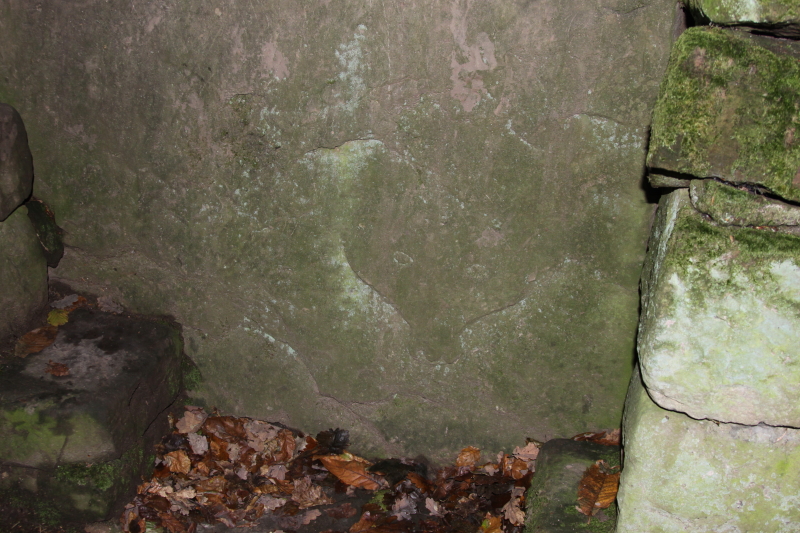
We continued our walk back through some areas owned by the Forestry commission and eventually back down a slope to where we started. Conversation drifted from edible fungi to forest management to making pesto from wild garlic and training of Spaniels and much more besides. It was a good walk, I hope I have remembered what Mack told me accurately, I am sure I will see him again and no doubt find out a bit more about local history.


hi there,i think you will find it was italian prisoners in ww2
oh and the pile of stones were constructed to form a gun turret
Oh, more info, my man said it was a look out post so the overseer could keep an eye on the prisoners. So that is a similar use. I must say the wall looks in a fairly good state of repair suggesting a more recent construction.
OK, you may be right but I was quoting from a local chap who seems to know a lot about the area and the history.
Do you have a source for your info…..is your second name Rossi or Pirolini??? for example.
The walls look rather older than second world war period, as does a lot of the other masonry in the area. I would find it easier to believe that they were constructed by Napoleonic prisoners who would have been expected to work until they dropped, rather than by second world war P.O.Ws, subject to certain restrictions under the Geneva Conventions- the walls are monumental in scale. Well built dry stone walls can survive for hundreds of years, especially if they are on a farm or estate where they are looked after. Everything about the immediate area suggests this is such a farm. Further more they are surrounded-closely-by very large old beech trees. Looking at how close the trees are to the walls in many cases, the walls must have been there BEFORE the trees, which means they must be considerably more than 70 odd years. There are also many other stone remnants in the woods-too many, too ruined to be from the 1940s. Furthermore, almost any second world war site would be likely to have-not a gun turret constructed beautifully out of stone, but something concrete, with slits in it, probably incorporating corrugated tin and barbed wire.
I have no difficulty believing that Italian POWs WERE set to work on the land in and after WW2, but I think they were preceded by prisoners of an earlier war, who had a much tougher time.
Yes, I agree. Thank you for your detailed comments. I too had noticed that the trees growing out of or very close to the walls were of some age so suggesting that the wall must be even older and thus much earlier than WW2.