Tags
Ancient Woodland, Ancient woodland indicators, Ancient woodland species in Wales, Deer Damage, Indicator species for ancient woodland, Ninewells Wood, Ninewells Wood species list
Ancient semi-natural woodlands are defined as woodlands which have been in existence for over 400 years. This is not to be confused with original woodland or as some authors call it Wild wood. There is probably no true wild wood left in the UK, wild wood being wood which developed after the last glacial period and has been in existence ever since without any interference from man, ie no coppicing, or removal of certain trees for timber or charcoal for smelting, and no planting. Just left to its own devices to regenerate in its own sweet way.
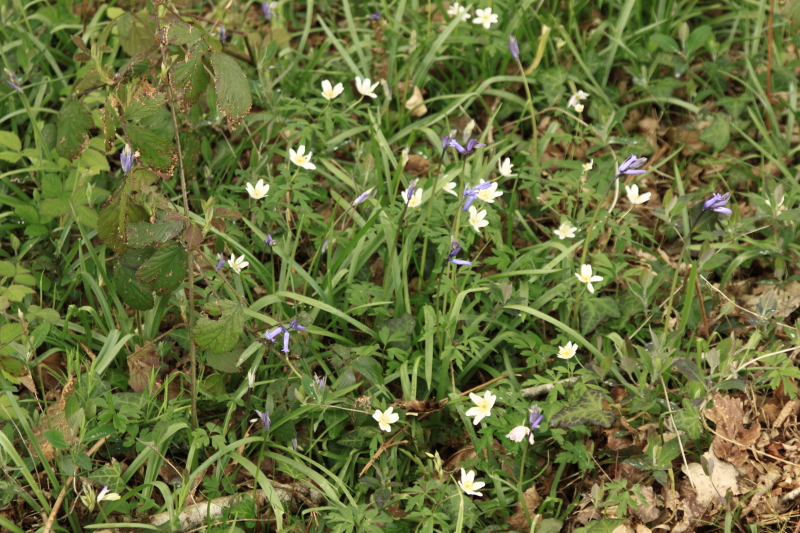
Anemones and bluebells
However there are woods which will have had woodland growing on that site ever since the last glaciation, and these woods will have a rich and distinctive flora. Many woodland plants are very slow to colonise, partly because their dispersal is not that efficient and for many they reproduce largely asexually, ie they do not produce seeds and rely on bulbs and corms to maintain their presence and to slowly, very slowly spread. There are several web sites where you can find lists of plants which indicate that a woodland is quite old or ancient. Below is a list which I have copied from The Woodland Trust….. and then I have highlighted the plants which I have found in Catbrook wood highlighted in green and Ninewells wood highlighted in red. There seems to be some omissions from this list like Herb Paris and Yellow Archangel, but as they explain on their website, this list is made up from species found on 129 known ancient woodland sites and it could be that the two I have mentioned are quite rare and so were not present in the sites they used. They say that ‘Of the 63 species on the list, 41(indicated by *) also appear on other UK lists of ancient woodland species, determined by expert judgement’
| Latin name | Common name |
| Ajuga reptans | Bugle |
| Anemone nemorosa* | Wood anemone |
| Arum maculatum* | Lords-and-ladies |
| Atrichum undulatum* | Common smoothcap |
| Betula pubescens | Downy birch |
| Blechnum spicant* | Hard-fern |
| Brachypodium sylvaticum* | False brome |
| Calliergonella cuspidata | Pointed spear-moss |
| Cardamine flexuosa* | Wavy bitter-cress |
| Carex remota* | Remote sedge |
| Carex sylvatica* | Wood-sedge |
| Chrysosplenium oppositifolium* | Opposite-leaved golden-saxifrage |
| Circaea lutetiana* | Enchanter’s-nightshade |
| Conocephalum conicum | Great scented liverwort |
| Conopodium majus | Pignut |
| Corylus avellana* | Hazel |
| Crepis paludosa | Marsh hawk’s-beard |
| Dicranum scoparium* | Broom fork-moss |
| Digitalis purpurea | Foxglove |
| Diplophyllum albicans | White earwort |
| Dryopteris affinis* | Scaly male fern |
| Eurhynchium praelongum | Common feather-moss |
| Eurhynchium striatum* | Lesser striated feather-moss |
| Galium odoratum* | Woodruff |
| Galium palustre | Common marsh-bedstraw |
| Geranium robertianum* | Herb-robert |
| Geum urbanum | Wood avens |
| Glyceria fluitans | Floating sweet-grass |
| Hedera helix | Ivy |
| Hyacinthoides non-scripta* | Bluebell |
| Hypericum pulchrum* | Slender St John’s-wort |
| Isothecium myosuroides* | Slender mouse-tail moss |
| Lapsana communis | Nipplewort |
| Lonicera periclymenum* | Honeysuckle |
| Luzula pilosa* | Hairy wood-rush |
| Luzula sylvatica* | Great wood-rush |
| Lysimachia nemorum* | Yellow pimpernel |
| Mentha aquatica | Water mint |
| Orchis mascula* | Early-purple orchid |
| Oxalis acetosella* | Wood sorrel |
| Pellia epiphylla | Overleaf pellia |
| Plagiomnium undulatum | Hart’s-tongue thyme-moss |
| Polypodium interjectum | Intermediate polypody |
| Polystichum aculeatum* | Hard shield-fern |
| Potentilla sterilis* | Barren strawberry |
| Prunus spinosa | Blackthorn |
| Ranunculus ficaria | Lesser celandine |
| Rhizomnium punctatum* | Dotted thyme-moss |
| Rhytidiadelphus loreus* | Little shaggy-moss |
| Rhytidiadelphus triquetrus* | Big shaggy-moss |
| Rosa canina | Dog-rose |
| Salix caprea* | Goat willow |
| Salix cinerea | Grey willow |
| Sanicula europaea* | Sanicle |
| Senecio aquaticus | Marsh ragwort |
| Sorbus aucuparia* | Rowan |
| Stellaria holostea* | Greater stitchwort |
| Stellaria uliginosa* | Bog stitchwort |
| Thuidium tamariscinum* | Common tamarisk-moss |
| Vaccinium myrtillus* | Bilberry |
| Valeriana officinalis* | Common valerian |
| Veronica montana* | Wood speedwell |
| Viola riviniana* | Common dog-violet |
Other sites with lists that you might find useful are 1. The Natural History Museum list OK apologies to the Woodland trust but I do not like your list so I have presented another one…. this one was compiled by Professor Oliver Rackham and it can be viewed by clicking HERE.


Do you intend to try to re-introduce any of the native species? Amelia
No,because each woodland is unique.
Are you hoping there might still be seed banks lying dormant in the soil that might now germinate if the conditions are favourable?
Yes, I am really looking forward to this Spring to see what grows. Already though lots of different sedges and grasses have popped up, I will be able to identify them latter in the year when they get bigger and produce flowers. Also there are lots of Foxgloves which will look good later this year. There is some Heather (Calluna) and quite a lot of Gorse already appearing.
I am preparing a better list of indicator species for ancient woodland, the one I posted earlier does not seem to be in line with the accepted norms. I have referred to Oliver Rackham who is the undisputed expert on Woodlands. I will be posting that list in a couple of days time.
With regards to your earlier question about introducing woodland species, no, I want it to be as natural as possible, not a garden! I am only introducing a few tree species and even then I am sourcing the seeds from trees growing as close to my wood as possible. Also no species which were not already there. ie I am putting in Beech and Hazel but no Ash, even though there is some Ash not 200 yards away, but in some ones garden…… I am very fussy as you know.
I was not suggesting you might introduce garden species only those native species that are naturally found in ancient woodlands. However, patience is a virtue and it is much wiser to see what comes up as the woodland evolves. Amelia
Yes I see but in my book even introducing native species which are naturally found in ancient woodland is a step too far. Each region and even each, woodland will only support a proportion of the total list of known ancient woodland species, so putting in wild daffodils or ramsons is still gardening. I will be content with whatever is there or arrives naturally.