Tags
Ancient Woodland, Catbrook wood, Indicator species for ancient woodland, Monmouthshire woodlands, Ninewells Wood, Ninewells Wood species list, Oliver Rackham, Wye valley
I was not happy with the list of species which indicate ancient woodland that I published a couple of weeks ago. There seemed to me to be some species missing which are always quoted as indicators of ancient woodland also it included quite a lot of bryophytes which most people find difficult to identify.
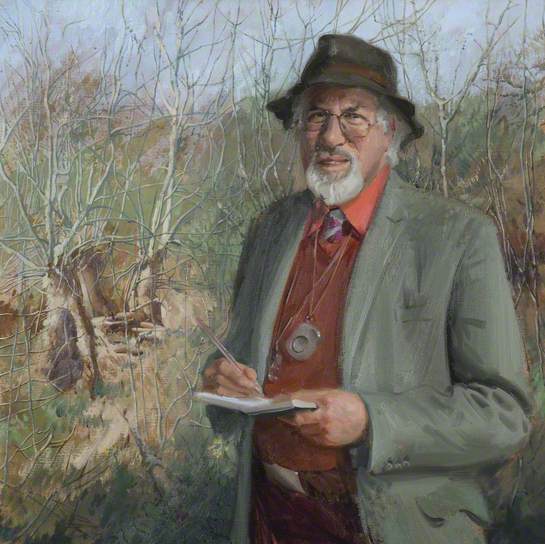
Painting of Professor Oliver Rackham in Corpus Christi Cambridge.
So I referred to the acknowledged authority on woodland Oliver Rackham, (Professor of Historical Ecology; Cambridge) who has published many excellent books on woodlands. In his recent book ‘Woodlands’ he has published a list, which as he says is made up from 18 regional lists. He presents the list in the order of how many local lists a particular species appears on. So top of the list is the grass Wood Mellick, Mellica uniflora which scores 18 as it is the only species which was recorded on all 18 regional lists.
Here is his composite list Common name first, Latin name next and the number out of 18 indicating how many regional lists it appears on. I have only represented species which score 4 or more. His list is longer and includes all species.
Wood Melic Mellica uniflora 18
Woodruff Gallium odoratum 17
Wood Anemone Anemone nemorosa 15
Hairy Woodrush Luzula pilosa 15 (Click link)
Wild Service Tree Sorbus torminalis 15
Common Cow-wheat Melampyrum pratense 14
Wood Millet Milium effusum 14
Small-leaved Lime Tilia cordata 14
Moschatel Adoxa moshatellina 12
Wood Spurge Euphorbia amygadaloides 12
Herb Paris Paris quadrifolia 12
Thin-spiked Wood Sedge Carex strigosa 11
Pale Sedge Carex pallescens 10
Pendulous Sedge Carex pendula 10
Remote Sedge Carex remota 10
Bird’s Nest Orchid Neottia nidus-arvis 10
Wood-sorrel Oxalis acetosella 10
Wood-speedwell Veronica montana 10
Ramsons Allium ursinum 9
Lilly of the Valley Convallaria majalis 9
Yellow Archangel Galeobdolon luteum 9
Bearded Couch Grass Agropyron caninium 8
Smooth-stalked Sedge Carex laevigata 8
Yellow Corydalis Corydalis claviculata 8
Crab Apple Malus sylvestris 8
Early Purple Orchid Orchis mascula 8
Wood Sedge Carex sylvatica 7
Pignut Conopdium majus 7
Giant Fescue Festuca gigantean 7
Toothwort Lathrea squamaria 7
Nettle-leaved Bellflower Campanula trachelium 6
Scaly Male Fern Dryopteris affinis 6
Broad-leaved Helleborine Epipactis helleborine 6
Bitter Vetch Lathyrus montanus 6
Great Wood-rush Luzula sylvatica 6
Yellow Pimpernel Lysimachia nemorum 6
Butterfly Orchid Platanthera chlorantha 6
Pale Wood Violet Viola richenbachiana 6
Hairy Brome Bromus ramosus 5
Wood Small-reed Calamagrostis epigejos 5
Violet Helleborine Epipactis purpurata 5
Water Avens Geum rivale 5
Green Hellebore Helleborus viridis 5
Wood Barley Hordelymus europaeus 5
Tutsan or Sweet Amber Hypericum androsaemum 5
Wood Meadow Grass Poa nemoralis 5
Sanicle Sanicula europoea 5
Wood Club-rush Scirpus sylvaticus 5
Wood Vetch Vicia sylvatica 5
Columbine Aquilegia vulgaris 4
Meadow Saffron Colchicum autumnale 4
Midland Hawthorn Crataegus laevigata 4
Hay-scented Buckler Fern Dryopteris aemula 4
Three-nerved Sandwort Mochringia trinerva 4
Wood Forget-me-not Myostis sylvatica 4
Wild Daffodil Narcissus pseudonarcissus 4
Solomons Seal Polygonatum multiflorum 4
Aspen Populus tremula 4
Golidilocks Ranunculus auricomus 4
Figwort Scrophularia nodosa 4
The list continues with plants that only occur in 3 or 2 or 1 of the 18 lists that Oliver Rackham referred to but it gets quite long and less relevant. Surprisingly Bluebells comes in this final section, I would have thought it would have been much higher. Also no mention of Dog’s Mercury which I would have thought was a typical ancient woodland plant, maybe it regenerates too easily.
In any particular wood only a certain number of the above species could possibly exist, because some species are restricted to alkaline soils and others will only live on acidic soils. Also some species are only found in the south so a northern woodland might be too cold to support certain species.
I will highlight species which I have seen in Ninewells wood and also underline those which occur in my section of Ninewells wood which is called Catbrook wood. Also as time goes by I will endeavour to link each species to an in-depth post on that specific species so that you can find out more about each species and check out if it is growing in your woodland or area. I have already done this for Hairy Woodrush.


Pingback: Indicator species of Ancient woodland in Ninewells wood | Ninewells Wood/Catbrook Wood
Pingback: Woodland plants of the Wye Valley; Bluebell ( Hyacinthoides non-scripta ) | Ninewells Wood/Catbrook Wood
Pingback: Woodland plants of the Wye valley; Wood-sorrel (Oxalis acetosa) | Ninewells Wood/Catbrook Wood
Pingback: Woodland flowers of the Wye valley; Yellow Archangel (Lamium galeobdolon) | Ninewells Wood/Catbrook Wood
Pingback: Woodland flowers of the Wye Valley: Solomon’s Seal (Polygonatum multiflorum) | Ninewells Wood/Catbrook Wood
Pingback: Yellow Archangel, Lamium galeobdolon – Woodland Wildflowers
Pingback: Bluebell Hyacinthoides non scripta – Woodland Wildflowers