 To many people a slug is a slug is a slug. However there are many different species and in a British woodland you could come across at least a dozen different ones. This chap made an appearance yesterday in our patch of Ninewells wood. I had been shifting some old logs about and had sat down for a rest when he/she came slip sliding along.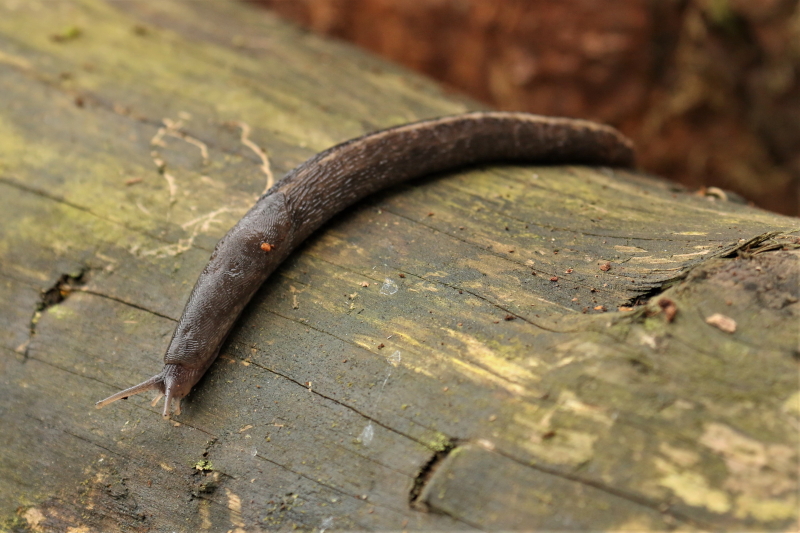
Incidentally he/she is a good description as along with snails they are both. ie hermaphrodites.
To identify these creatures we need to know a bit of terminology about their shape and structure (morphology) because they are more complicated than just a long blob or a homeless snail. Here is a diagrammatic slug. Not all slugs have all these features but this gives us the names of all their bits.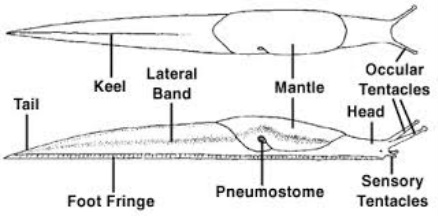
This slug has a keel, not all do, and it is a cream colour. It is also quite long, about 10cm although you can’t tell that from the photo. This is enough to identify it as the black keel back slug (Limax cinereoniger) This slug has another common name, which is the Ash-grey Slug; not terribly inspired but I suppose it does describe the colour. Sometimes they have three darker lateral bands on either side of the keel. They will grow up to 20cm long which makes this the largest of the Keel slugs, even bigger than the Leopard slug (Limax maximus) which only grows to 15cm long.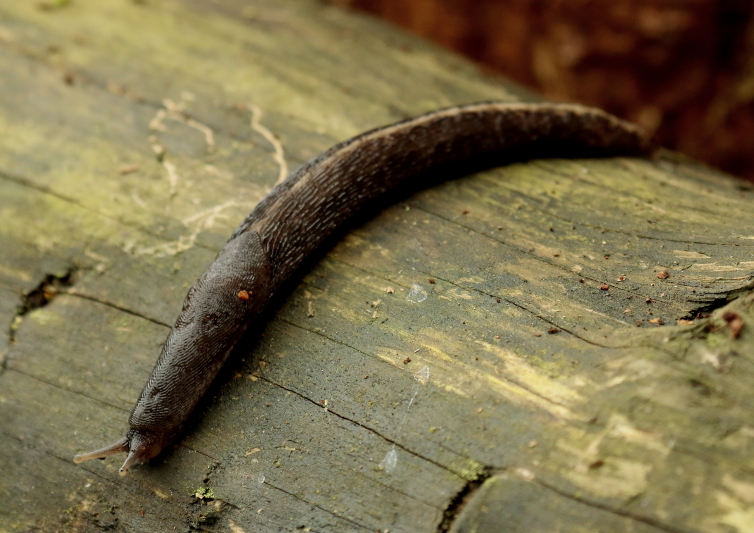
As I indicated earlier the slugs are hermaphrodite so each individual has both male and female parts and produces sperm and eggs. Normally two individuals come together and entwine and sperm form both individuals is passed across to the other mating pair ( twice the fun at the same time). However in this species if a partner is hard to find then individuals can self fertilise, not so much fun and of course no genetic mixing.
These slugs are the largest found in Europe and will live for about 3 years, they largely feed on fungi and algae but will also feed on carrion, eating dead animals.
For more info on slugs and help with identification I refer you to,

