Tags
Galanthus nivalis, Llandogo, Snowdrop, Welsh woodland, Woodland flowers, Wye valley, Wye valley woodlands
Well, it is widely accepted now that Snowdrops are not a native British species… but then again so many of us are not truly native, whatever that is, so should we hold that against the snowdrop and not include them in the list.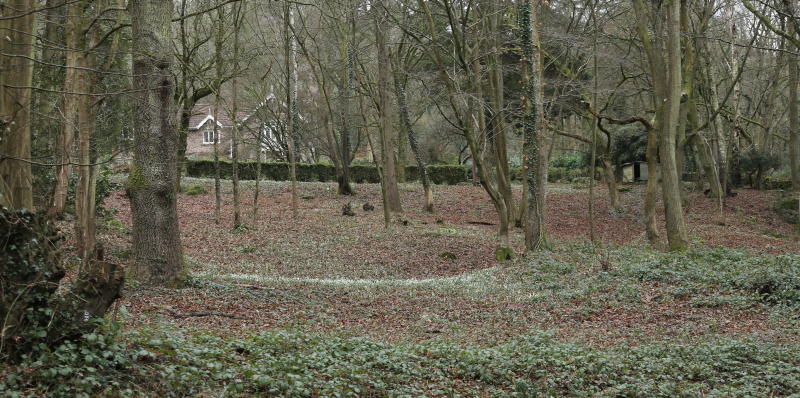
They are described as ‘naturalised’ meaning that they have become part of the British countryside, growing alongside other wild flowers without any help or input from man.
However it is rare to find them growing any distance away from a house or the former site of a building. As shown in the photo above. These are growing down a slope from a large house situated just on the outskirts of Llandogo in the Wye valley. I have read that the first area where they became naturalised was Gloucestershire and Worcestershire, though at what point a plant changes it status from an escapee to becoming naturalised I do not know.
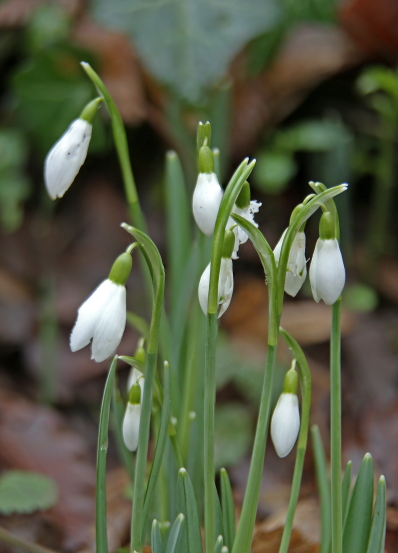 There are many different species of snowdrop, but the one we have is called Galanthus nivalis The name was created by Linnaeus and Gala is milk anthos is flower and nivalis refers to snow, neige in French. So it is a milk coloured flower which blooms when there is snow…. sounds sensible to me.
As I said there are many species and these mostly come from the middle east. Galanthus nivalis is the most widespread, being found from the middle east and right across Europe into France, Belgium and Holland. Recently some of the species have been challenged with advances in genetics and DNA fingerprinting. Also there are many ‘garden cultivars’, man cant resist trying to improve on nature. So we have double versions, strains in which the green colour on the petals is missing or has been substituted with yellow, in fact man has produced over 500 different cultivars….Why? If you look at the photo below, these snowdrops look a bit different to the ones above, they are more full and rounder. These ones are growing on a bank on a road up from Bigswier towards Clearwell. They are not that far from a couple of houses.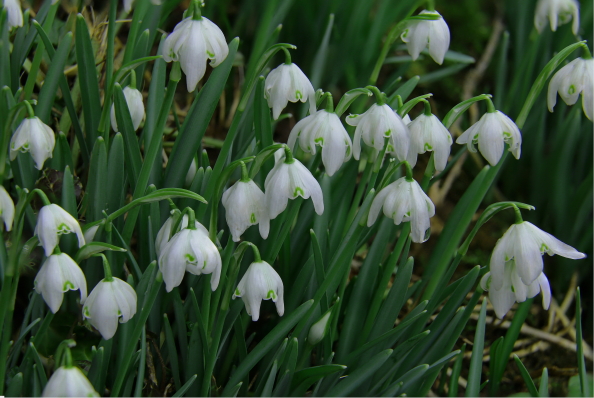
Now lets return briefly to the flower structure. I said petals but actually they are strictly called Tepals as the flowers does not have separate sepals and petals, but a sort of all in one version which does the job of both sepals ( protecting the flower whilst in bud) and petals (looking pretty and attracting insects). It has three outer tepals; the longer white concave jobs and three inner tepals which are shorter and form a little tube and have the green markings on.
Snowdrops are the first wild/naturalise flowers to bloom in spring, Aconites also flower early early but they are definitely garden bulbs. They might have been introduced by the Romans but more likely in the 16th century. They spread largely by increasing the number of bulbs in the ground and not by seeds, so that is quite a slow process but does result in dense colonies of them.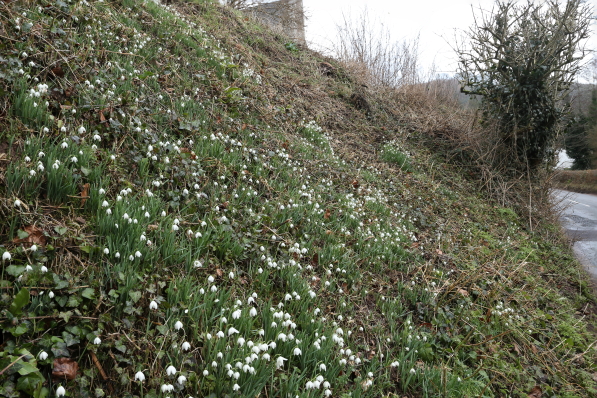
To check out other wildflowers found in the woods of the Wye valley and Ninewells wood click Woodland Wildflowers of the Wye valley and Monmouthshire.


Sort of sad, I thought snowdrops were British. Do you know why they do not thrive here? Do they need cold? By the way it is neige not niege. Amelia
Hi, if you look on Wikipedia there is a map of their distribution and there is a broad region diagonally across central France where they are not native, they then reappear across northern France/Belgium. This may be weather conditions, but you are in the region that they do not like for what ever reason.